
Smoke Fire Restoration Cheltenham
 (459)
(459)
(459)

Smoke and Fire Restoration | Plumber On Demand
Soot, Smoke Odor, and Structural Cleanup After Fire—Not a Water-Only Job
A fire does not have to destroy a room to make a building unlivable. Soot films, smoke odor, and HVAC contamination can spread far beyond where flames were visible.
Firefighting water can then create a second loss: soaked drywall, wet insulation, and standing water in areas that never burned.
Smoke and fire restoration means stabilizing the structure, cleaning soot, addressing odor sources, protecting contents, and handling that dual fire-and-water reality when it exists.
At Plumber On Demand, smoke and fire restoration focuses on soot, smoke odor, HVAC contamination, contents cleaning, structural cleaning, and board-up after a fire.
We distinguish charred assemblies from smoke-only rooms, and we treat firefighting water as its own problem when suppression soaked the building.
If you need smoke and fire restoration after a kitchen fire, electrical fire, or smoke-only event, contact Plumber On Demand today at 905-220-5006 to schedule an assessment.
What Smoke and Fire Restoration Is
Smoke and fire restoration is the process of making a fire-affected building safe to occupy again by addressing combustion residues, odor, and related water damage.
Restoration after fire typically includes:
- Board-up and stabilize (openings, unsafe finishes, weather protection)
- Assessment of char vs. smoke-only vs. soot-only areas
- Structural cleaning of walls, ceilings, framing, and hard surfaces
- Contents evaluation, pack-out, and cleaning when items can be salvaged
- HVAC inspection for soot and odor in ducts and air handlers
- Odor reduction using controlled methods (including ozone or hydroxyl in appropriate, unoccupied setups—described generally below)
- Drying and water mitigation when firefighting water is present
- Documentation of conditions for your own records or insurer conversations
This is not a water-damage article with fire mentioned in passing. The primary contaminants are soot and smoke. Water is a companion loss, not the whole job.
Why Smoke and Fire Restoration Matters
Soot is acidic and can etch surfaces. Smoke particles embed in porous materials. HVAC systems can recirculate odor and residue into rooms that never saw flame.
Professional restoration matters because:
- Soot residues can stain and corrode if left in place
- Odors return when contents and cavities are not addressed
- Painting over soot often fails as the residue bleeds through
- Ducts can re-soil cleaned rooms
- Firefighting water starts a clock on wet materials
- Unsafe openings after a fire need board-up before weather and trespass add damage
Delay often means more contents lost, more odor in framing, and a dual loss (fire plus water) that is harder to separate later.
Char vs. Smoke-Only vs. Soot Film
Not every fire-affected room is the same.
• Char
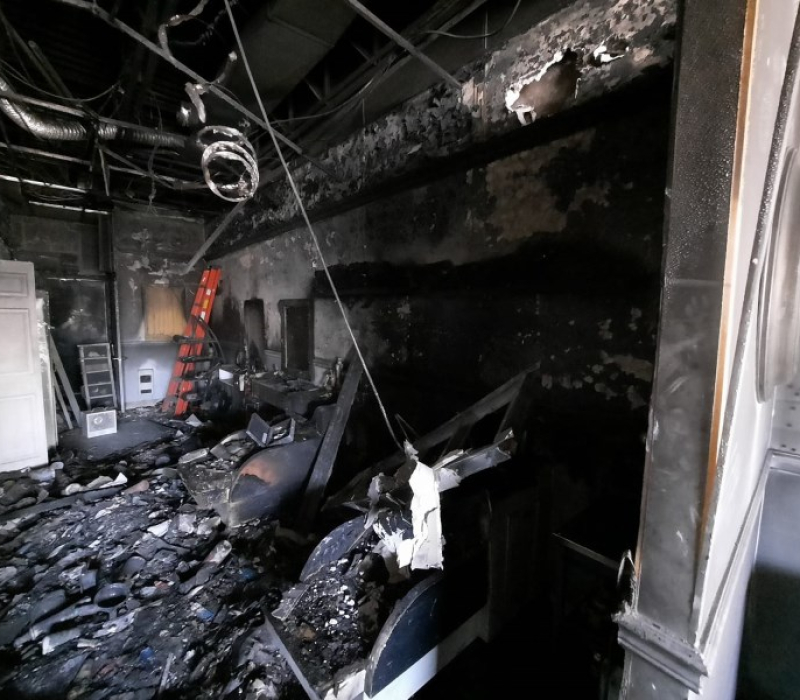
Heat has burned or deeply damaged the material. Charred framing, cabinets, or drywall often cannot be “cleaned back” to a finish-ready surface. Removal and replacement of those assemblies is common.
• Smoke-Only
No flame reached the room, but smoke did. Walls may have a film, contents may smell, and HVAC may have pulled residue. Cleaning and odor work may restore many surfaces that are not heat-damaged.
• Soot Film Without Heavy Smoke Travel
A small, contained event can still leave a greasy or dry soot film on nearby surfaces. The cleaning method depends on whether the soot is protein (often from kitchen fires), oily, or dry/powdery.
Mixing these categories in one vague “total loss” description leads to the wrong scope: over-demolishing smoke-only rooms or under-cleaning rooms that only look lightly affected.
When Smoke and Fire Restoration Is Needed
Call for a fire restoration assessment when:
- There was a cooking, electrical, or contents fire
- Firefighters entered the building or used water
- You smell smoke in rooms that look almost normal
- Soot is on walls, ceilings, or contents
- HVAC ran during or after the fire
- Windows or doors were broken for access or ventilation
- A neighboring unit had a fire and smoke entered yours
- You are unsure what is charred vs. only smoke-stained
Even a “small” stove fire can contaminate cabinets, nearby rooms, and the air system.
Soot: What It Is and Why Cleaning Method Matters
Soot is the particulate leftover from incomplete combustion. Kitchen (protein) soot, plastic fires, and wood fires do not behave the same on surfaces.
Soot-related work often includes:
- Identifying residue type by appearance and source (kitchen vs. contents vs. structure)
- Dry-cleaning methods on some surfaces before wet cleaning
- Controlled wet cleaning on others
- Deciding which porous materials will hold odor permanently
- Protecting unaffected rooms from tracking soot on shoes and equipment
Aggressive wiping without a plan can grind soot into paint. Restoration cleaning is sequenced, not improvised.
Smoke Odor: Sources, Not Just Smell
Odor is a symptom of residue in materials, contents, and air pathways. Opening windows helps briefly. It does not remove soot from insulation, drapes, or duct liners.
Odor sources commonly include:
- Soft contents (textiles, upholstery, clothing)
- Porous building materials
- HVAC filters, coils, and duct interiors
- Charred materials that were never removed
- Voids above ceilings and inside wall cavities
- Refrigerators, cabinets, and other enclosed spaces that trapped smoke
Odor work is tied to removing or cleaning the source. Odor equipment is a supplement, not a substitute for cleaning.
HVAC Contamination After a Fire
If the system ran, or if returns pulled smoke, the air distribution system can be part of the loss.
HVAC-related restoration may involve:
- Replacing filters that loaded with soot
- Inspecting supply and return registers
- Evaluating duct interiors for residue
- Cleaning accessible components as appropriate
- Advising when sections of duct or insulation cannot be effectively cleaned
- Keeping the system off until a plan is in place, when that is the safer choice
Turning the furnace or air conditioner back on too soon can redistribute soot into rooms that were just cleaned.
Board-Up and Stabilize
After a fire, openings and unstable finishes can invite weather, animals, and further damage.
Stabilize steps often include:
- Boarding broken windows and doors
- Temporary roof or opening protection when fire vented the structure
- Making unsafe hanging materials safe or removing them
- Controlling access to charred rooms
- Separating severely damaged zones from smoke-only zones when practical
Board-up is not cosmetic. It protects the building so cleaning and drying can proceed without a second weather loss.
Firefighting Water: The Dual Loss
Water used to extinguish a fire is a separate damage mechanism. Wet drywall, insulation, and flooring next to a charred kitchen are a fire-plus-water event.
Dual-loss restoration typically requires:
- Extraction of standing water
- Moisture measuring in rooms that never burned
- Drying of wet assemblies that are not charred
- Removal of materials that are both burned and soaked
- Documentation that distinguishes heat damage from water damage
Ignoring the water because “it was a fire” is how swollen floors show up after the soot is gone. Ignoring the soot because “we have to dry first” is how odor gets locked into a rushed rebuild. Sequence both problems.
Contents Cleaning and Pack-Out
Contents are often salvageable even when the room looks dramatic—or unsalvageable even when the room looks fine.
• Pack-Out
Pack-out means inventorying, packing, and moving contents to a controlled setting for cleaning or storage so structural work can proceed.
Pack-out is useful when:
- Rooms must be emptied for structural cleaning or demolition
- Contents need specialized soot cleaning
- Occupants cannot stay and items must be protected
- Inventory is needed for your own records or an insurer file
• What Gets Cleaned vs. Discarded
Hard, non-porous items often clean well. Heavily charred items, melted plastics, and porous goods that absorbed heavy smoke may not. We describe condition; we do not assign settlement values.
Structural Cleaning
Structural cleaning addresses the building itself: walls, ceilings, trim, framing (when exposed), hard floors, and fixtures.
Structural cleaning may include:
- Soot removal from painted surfaces using appropriate methods
- Cleaning of hard flooring and non-porous trim
- Work on exposed framing after charred drywall is removed
- Fixture and cabinet cleaning when those items are staying
- Controlled cleaning so residue is not pushed into unaffected rooms
If a surface is charred, cleaning is not a substitute for replacing the damaged assembly.
Odor Reduction: Ozone and Hydroxyl (General Description)
After sources are cleaned or removed, some projects use equipment intended to reduce remaining odor in air and on surfaces. Two methods you may hear about are ozone generators and hydroxyl generators.
In general terms:
- These tools are used as part of a plan, after cleaning—not as a way to skip soot removal
- Occupants, pets, and plants should not occupy a space being treated with ozone; hydroxyl use also follows equipment-specific safety guidance
- Results vary with residue load, materials, and whether hidden sources remain
- No odor machine “guarantees” a permanent result if charred materials or dirty ducts are still in place
We describe these methods carefully and do not overclaim. If odor remains, the next step is usually finding an untreated source—not running a machine longer as a substitute for cleaning.
Our Smoke and Fire Restoration Process
• Safety and Access
We confirm the fire is out, the structure is safe to enter as directed by officials, and utilities are in an appropriate state.
• Board-Up / Stabilize
Openings and hazards are addressed so the building is protected.
• Assessment: Char, Smoke, Soot, Water
We map which rooms burned, which only received smoke, and which were wetted by suppression.
• Contents Decisions
We identify pack-out, on-site cleaning, and discard candidates.
• Structural Cleaning and Demolition of Unsalvageable Assemblies
Charred materials come out. Cleanable surfaces are cleaned with methods matched to the soot type.
• HVAC Evaluation
Filters, registers, and accessible ducts are considered so cleaned rooms are not re-contaminated.
• Water Mitigation When Present
Extraction, moisture measuring, and drying run in parallel with fire cleanup when suppression water is part of the loss.
• Odor Follow-Through
After sources are addressed, additional odor steps may be used where appropriate, with clear limits on what they can do.
• Next-Step Recommendations
Rebuild, painting, and re-occupancy timing depend on cleaning completeness, dryness, and odor sources—not on a single calendar date.
Smoke and Fire Restoration for Residential Properties
Home fires often start in kitchens, laundry rooms, or from electrical devices, then affect:
- Adjacent living rooms via smoke
- Bedrooms via HVAC
- Contents throughout the home
- Attics if smoke rose and cooled on framing
- Lower levels if water from suppression ran downward
Homeowners need a plan that separates the burned room from smoke-only bedrooms, and that does not ignore wet carpet in the hall.
Smoke and Fire Restoration for Commercial Buildings
Commercial fires add occupancy, food-service grease residues, multi-tenant smoke travel, and business-hour constraints.
Commercial scopes often include:
- Restaurant or kitchen protein soot
- Retail inventory affected by smoke
- Office contents and electronics
- Shared corridors and HVAC in multi-tenant buildings
- After-hours cleaning so operations can resume in unaffected zones
- Coordination with building management and other tenants
Warehouses, offices, restaurants, retail, and multi-unit residential buildings each need a mapped soot and smoke boundary—not a one-room assumption.
Residential vs. Commercial: Practical Differences
Homes often need pack-out of personal belongings and careful odor work in closets and textiles.
Commercial sites often need:
- Inventory handling for merchandise
- Grease-and-soot combinations in food service
- Life-safety and re-occupancy coordination
- Documentation for owners, tenants, and insurers
- Phased cleaning so part of the building can operate
The contaminants are still soot and smoke. The logistics change with the building type.
Cost and Scope Factors
Smoke and fire restoration cost follows the real extent of residue, char, contents, HVAC, and water—not the size of the original flame.
Scope drivers include:
- Square footage of soot vs. square footage of char
- Number of rooms with odor but no flame
- HVAC involvement
- Volume of contents and whether pack-out is required
- Firefighting water and how far it traveled
- Board-up needs
- Materials that must be removed rather than cleaned
A smoke-only apartment can be a large cleaning job. A small, fully charred closet can be a small demolition job. They are not priced the same way.
Related Insurance Notes
Fire, smoke, and suppression water may be reviewed as related parts of one event, but documentation should still separate what burned, what was smoked, and what was wetted.
Keep in mind:
- We do not file claims or guarantee coverage
- Photos of char vs. smoke-only rooms help keep the file accurate
- Contents lists from pack-out support conversations about personal property vs. the building
- Sewer or drain issues are a different cause than fire; do not blend unrelated water sources into the fire story
- Coverage, deductibles, and additional living arrangements are policy questions for your insurer
Accurate restoration records describe conditions. They do not promise a payment.
Benefits of Hiring Plumber On Demand for Smoke and Fire Restoration
• Fire-First Scope
We treat soot, smoke, char, and HVAC as the core problem—not as a footnote to a water job.
• Dual-Loss Awareness
When firefighting water is present, drying and fire cleaning are planned together.
• Char vs. Smoke-Only Clarity
Rooms are not all labeled the same. Cleanable surfaces and unsalvageable assemblies are distinguished.
• Contents and Structure Together
Pack-out, contents cleaning, and structural cleaning are sequenced so one does not undo the other.
• Honest Odor Limits
Odor equipment is explained in general terms. We do not claim a machine will fix untreated residue.
Kitchen Fires and Protein Soot
Cooking fires often leave a thin, sticky film that is easy to underestimate. Cabinets, nearby rooms, and light fixtures can be affected even when flames stayed in a pan.
Kitchen-related restoration often focuses on:
- Residue on painted surfaces and cabinets
- Contents in adjacent rooms
- Range hoods and nearby HVAC returns
- Whether pantry goods and exposed food should be discarded
- Smoke travel to upper floors
Protein soot cleaning is a specific technique problem. Household wiping frequently smears it.
Electrical and Contents Fires
Melted plastics and wiring can produce strong odors and a different soot chemistry than wood or kitchen fires.
These events often involve:
- Localized char at an outlet, appliance, or device
- Heavy odor in a small area
- Smoke that traveled farther than the heat
- Electronics and plastics that may not be cleanable
The burned item is not the whole loss. The smoke path is.
Multi-Unit and Neighboring-Unit Smoke
Smoke does not respect suite lines. A fire in one unit can contaminate hallways, HVAC shafts, and apartments that never had flame.
Restoration in these settings may require:
- Corridor and common-element cleaning
- In-suite odor and soot checks for neighbors
- Coordination with property managers
- Careful HVAC decisions in shared systems
We document where smoke actually traveled instead of assuming only the fire unit is involved.
Areas We Serve
Plumber On Demand provides smoke and fire restoration for residential and commercial properties across a wide range of communities.
We work with:
- Homeowners and occupants
- Landlords and property managers
- Business owners and facility managers
- Multi-unit building stakeholders
- Contractors coordinating rebuild after fire
- Real estate professionals dealing with a fire-affected property
Why Cleaning Before Painting Matters
Paint over soot is a common DIY failure. Residue can bleed through, and odor can remain in the film.
Professional sequence is typically:
- Remove charred materials
- Clean remaining structure
- Address HVAC so the system will not re-soil surfaces
- Confirm wet assemblies are drying if water is present
- Then prime and paint with products suited to the situation
Skipping to paint because the room “looks better” often means doing the job twice.
Schedule Smoke and Fire Restoration Today
If soot, smoke odor, HVAC contamination, or firefighting water is affecting your property, Plumber On Demand can assess char vs. smoke-only areas and build a restoration plan.
Contact Plumber On Demand today at 905-220-5006 to schedule a smoke and fire restoration assessment.
Frequently Asked Questions About Smoke and Fire Restoration
• Is this the same as water damage restoration?
No. The primary job is soot, smoke, char, odor, contents, and HVAC. Firefighting water is a common second loss that we address when it is present.
• Can smoke-only rooms be cleaned instead of demolished?
Often yes, if there is no char and materials can be cleaned. Assessment distinguishes smoke-only from heat-damaged assemblies.
• Will ozone or hydroxyl remove all smoke smell?
Not by themselves, and not always. They are sometimes used after cleaning to help with remaining odor. Occupant safety rules apply, especially with ozone. Results vary; we do not guarantee odor elimination.
• Should I run my HVAC after a fire?
Usually not until the system is evaluated. Running it can spread soot and odor into cleaned or unaffected rooms.
• Do I need pack-out?
Pack-out is needed when contents must be removed for cleaning, storage, or to allow structural work. Small events may be handled on site. Assessment decides.
• What about water the fire department used?
That water can soak materials far from the fire. Extraction, moisture measuring, and drying should be part of the plan when suppression water is present.
• Can I just paint over the soot?
Painting without proper cleaning often fails. Residue can bleed through and odor can remain. Clean first.
• Do you file the insurance claim?
No. We document conditions and perform restoration work. You file with your insurer if you choose to. We do not guarantee coverage.
• How do you handle a kitchen (protein) fire?
Protein soot is often sticky and easy to smear. Cleaning methods are chosen for that residue type, and nearby rooms and HVAC are checked for travel.
• Can commercial kitchens and offices be restored after hours?
Yes. We work with access and occupancy so cleaning can proceed with less disruption when that is required.
• What is board-up for?
Board-up protects openings after a fire so weather, animals, and unauthorized entry do not add damage while restoration is planned.
• How do I get started?
Call Plumber On Demand at 905-220-5006 to describe the fire or smoke event and schedule an assessment. If officials have restricted entry, tell us so we can plan around safe access.
Contact Plumber On Demand Today
Smoke and fire restoration is about soot, odor, HVAC, contents, structural cleaning, and—when firefighters used water—a dual fire-and-water loss. It is not a job that ends when the flames are out.
Plumber On Demand provides smoke and fire restoration for residential and commercial clients, distinguishing charred assemblies from smoke-only rooms.
If you need board-up, soot cleanup, pack-out, or help with firefighting water after a fire, contact Plumber On Demand today.
📞 Call 905-220-5006
Speak with our team about your situation, request an assessment, and learn how smoke and fire restoration can help stabilize the building.