
Basement Leak Repair Toronto
 (459)
(459)
(459)

Professional Basement Leak Repair Services | Plumber On Demand
Finding and Sealing a Specific Leak Path—Cracks, Penetrations, Cove Joints, and Tie-Rod Holes
Basement leak repair is targeted work on a known water path. A crack weeps. A pipe sleeve leaks. A tie-rod hole stains. The cove joint wets in one corner. The job is to locate that path and repair it—not to rebuild an entire interior or exterior waterproofing system.
At Plumber On Demand, we provide basement leak repair for homes and commercial buildings. Diagnosis comes first: where the water actually travels, then a repair matched to that opening.
If a specific leak is wetting one area of your basement, contact Plumber On Demand today at 647-669-7444.
What Basement Leak Repair Means
Basement leak repair treats a point source. It is not “the basement is generally damp” as a chronic condition, and it is not a full-perimeter membrane or drain-tile project.
Targeted leak repair may include:
- Mapping which crack, joint, or hole is active
- Dye testing or controlled wetting to confirm the path
- Moisture readings to separate a leak from indoor condensation
- Injection or sealing of concrete and masonry cracks
- Packing and sealing of pipe penetrations and sleeves
- Repair of tie-rod holes and similar form-tie openings
- Cove-joint detailing where the wall meets the floor at a known wet spot
- Window-well leak paths at a specific opening
The result should be a dry leak location—not a promise that every future groundwater event is handled by a whole-building system. If the whole perimeter wets after every storm, that is a different scope.
Why Targeted Leak Repair Matters
A single opening can move a surprising amount of water under pressure. Hydraulic pressure at a crack or hole focuses flow. The rest of the wall can look fine while one path soaks a room.
Prompt basement leak repair helps:
- Stop water at the opening instead of managing puddles after every rain
- Protect stored items and finishes in the wet zone
- Avoid coating an entire wall when only one path is active
- Document the leak location for insurance conversations
- Decide honestly when a patch is enough and when a full system is needed
- Keep a small stain from becoming a long-term moisture problem at that point
Treating a point leak as if it were a whole-basement waterproofing project wastes money. Ignoring a point leak because “we might waterproof later” leaves an open path in the meantime.
Common Leak Paths in Basements
Water follows openings. Repair starts by naming the opening.
Typical point sources include:
- Shrinkage or settlement cracks in poured concrete walls
- Mortar-joint leaks in masonry
- Pipe, conduit, and sleeve penetrations through the wall or slab
- Tie-rod or form-tie holes left from original construction
- The cove joint at a specific corner or wall length
- Window and window-well joints that leak at one opening
- Cold joints between pours
- Floor cracks that wet only when the slab is under pressure at that line
These are not the same as a missing perimeter drain along every wall. A leak path is local. Chronic wet-basement conditions along the full footing are a system problem.
Signs You Have a Specific Leak (Not a Wet-Basement System Failure)
Leak repair is a good fit when:
- Water appears in the same spot after rain or snowmelt
- A crack shows a drip, a wet line, or a mineral stain
- A pipe entering the wall has a ring of dampness around it
- One window well wets the wall below it; others stay dry
- The cove is wet in one corner and dry everywhere else
- A tie-rod hole has a rust stain or a small active weep
- Indoor humidity is normal but one patch of wall is wet
Leak repair is a weaker fit when every wall wets at the cove, when the floor is generally damp, or when groundwater is clearly loading the entire footing. Those patterns point to drainage or full waterproofing—not a single patch.
Diagnosis: Dye, Moisture Mapping, and Watching the Path
Guessing the wrong crack wastes the repair. Diagnosis is the first half of the job.
• Visual Mapping
We start with where water is now, where stains are, and where stored items got wet. Old stains and new drips are not always the same path.
• Moisture Mapping
Meters help tell a surface leak from condensation, a plumbing drip, or a damp material that is no longer connected to an active path.
• Dye and Controlled Wetting
Where it is useful and safe, dye or controlled water at a well, crack, or grade can show whether that opening is the one that appears inside.
• Plumbing vs. Groundwater
A supply-line drip, a failed drain, or a heater pan is not a foundation leak. We separate plumbing sources from soil-side or crack-side entry before recommending crack work.
Diagnosis keeps the repair targeted. Without it, people inject the wrong crack and the real hole still runs.
Crack Leaks, Tie-Rod Holes, and Pipe Penetrations
Different openings need different repairs.
• Crack Leaks
Poured-wall cracks can weep under hydraulic pressure even when they look hairline. Repair may use injection or other crack-sealing methods suited to whether the crack is still moving and whether water is active.
• Tie-Rod Holes
Form ties leave small holes through the wall. They are classic point leaks: dry wall, wet hole. Filling and sealing that hole is leak repair, not a perimeter system.
• Pipe Penetrations
Pipes through walls and slabs need a seal at the sleeve. Water travels along the pipe if the annular space is open. Repair packs and seals that space; it does not replace the plumbing pipe unless the pipe itself is the failure.
Cove Joint and Window-Well Point Leaks
• Cove Joint
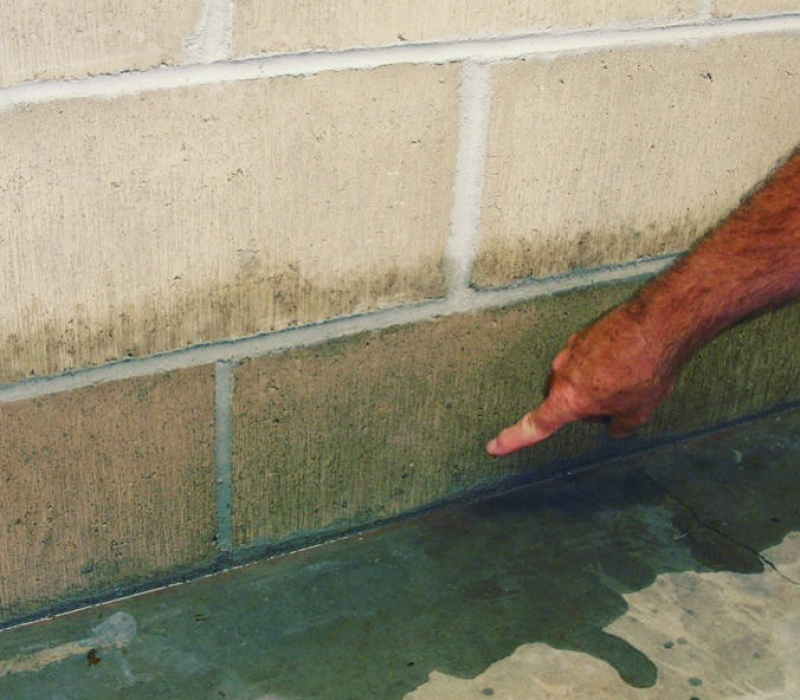
The cove is where the wall meets the floor. A short wet cove can be a local joint failure or a focused pressure point. A cove that wets all the way around the basement is usually drainage, not a one-spot patch.
Targeted cove repair is for a defined length that diagnosis ties to a joint or a local opening—not for “the whole basement is wet at the floor.”
• Window Wells
A well can leak at the window, at the well-to-wall joint, or down the wall below a ponding well. If only one opening is involved, repair can be localized: well drain, flashing, or the wall path under that window.
If every well and every wall is involved, you are back in system territory.
Why DIY Basement Leak Repair Is Risky
A tube of sealer on a dirty, wet crack often fails as soon as pressure returns.
DIY leak repair may:
- Seal the interior stain while water still travels in the crack
- Inject or caulk the wrong opening
- Trap water behind a surface coating
- Miss a pipe sleeve that is the real path
- Treat condensation as a foundation leak
- Assume one dry day means the crack is fixed
- Delay a needed drainage system because a cosmetic patch looked good for a week
Hydraulic pressure finds the remaining opening. Professional repair starts with the path, then the material, then confirmation that the spot stayed dry through a wet period when possible.
Our Basement Leak Repair Process
The sequence is find, confirm, repair, and verify—not coat the whole basement first.
• 1. Intake and Leak History
We ask when the water appears, whether it follows rain, and whether it is always the same location. Timing is a diagnostic clue.
• 2. Inspection and Moisture Mapping
We inspect cracks, penetrations, cove, wells, and nearby plumbing so the wet spot is not blamed on the wrong system.
• 3. Path Confirmation
Dye, controlled wetting, or other confirmation methods are used when they will actually identify the opening.
• 4. Surface Preparation at the Leak
Loose material, failed coatings, and debris come off the repair zone so the product can bond or inject.
• 5. Targeted Repair of the Opening
The crack, hole, sleeve, joint, or well path is repaired with a method matched to that opening—not a one-product approach for every basement.
• 6. Adjacent Check
We look for a second hole nearby. Point leaks sometimes travel to the next tie-rod or a parallel crack.
• 7. Cleanup of the Work Area
The repair zone is left in a condition you can assess. This is not full flood cleanup of a soaked building.
• 8. Documentation and Next-Step Honesty
You get photos and notes on what was repaired. If diagnosis showed a system-wide water problem, we say so instead of selling an endless series of patches.
Basement Leak Repair for Residential Properties
Homes often need targeted repair when:
- A rec room wall has one weeping crack
- A bathroom or laundry pipe penetration stains the basement side
- A storage corner wets at a single cove section
- A window well leaks at one opening
- Tie-rod holes show after a wet season
- A previous coating failed at one live crack
Families want that spot dry without tearing out the entire finished basement for a full waterproofing system.
When the leak is truly local, targeted repair is the proportional job.
Basement Leak Repair for Commercial Buildings
Commercial below-grade spaces can have many penetrations: conduits, sleeves, and equipment lines.
Commercial leak repair often addresses:
- A specific wall crack in a storage or mechanical room
- Pipe and conduit sleeves that weep under pressure
- Areaway or window openings that leak at one location
- Occupied-hour constraints for diagnosis and repair
- Documentation of the leak point for property records
A warehouse wall that is wet along the full length is not a leak-repair story.
A single sleeve that drips onto inventory is.
Basement Leak Repair for Landlords and Property Managers
Tenants may report “the basement leaks” when one storage locker or one unit’s lower wall is wet.
We assist with:
- Determining whether the complaint is a point leak or a building-wide seepage pattern
- Access to the actual opening, not only the room where water pooled
- Clear notes on crack vs. penetration vs. plumbing source
- Scheduling around occupied buildings
- Avoiding a full-system bid when a targeted repair is the honest scope—and the reverse
Patching a crack while a sewer is leaking is the wrong job. Diagnosis protects managers from both under-repair and over-repair.
Hydraulic Pressure at a Point
Water in soil acts like pressure on any opening. A small hole can produce a stream after rain even if the wall is thick.
That is why:
- Hairline cracks still leak
- Tie-rod holes become active in wet seasons
- A repair must hold against pressure, not only look closed when the wall is dry
- Surface paint over a live path fails
- Confirmation after a rain is more useful than a dry-day visual
Leak repair is pressure-path work. If pressure is loading the entire footing, draining that water with tile or an exterior system is the larger conversation.
Basement Leak Repair Cost Factors
Cost follows the opening and the access, not the square footage of the whole basement.
Factors that commonly affect cost include:
- Number of confirmed leak points
- Crack length, width, and whether the crack is still moving
- Type of opening (crack, sleeve, tie-rod, cove, window well)
- Access through finishes, storage, or occupied rooms
- How much diagnosis (mapping, dye, plumbing checks) is required
- Whether water is active during the repair
- Adjacent openings discovered during the work
- Whether the leak is actually a plumbing source instead of a foundation opening
One tie-rod hole is a different job than a long crack behind finished walls. An on-site assessment estimates the work.
Insurance and Leak Repair Documentation
Sudden, localized water through a failed opening may be viewed differently from long-term seepage, depending on the policy and the cause. We do not promise coverage.
Helpful documentation during basement leak repair includes:
- Photos of the wet spot, stain, and suspected opening before repair
- Notes on whether water follows rain, a plumbing event, or both
- Moisture readings or mapping that support a point source
- Photos of the opening during repair
- Records of what was sealed and what was ruled out
We do not file claims or interpret your policy. We capture the leak path so later conversations are based on observed conditions.
What Basement Leak Repair Does Not Include
Clarity here prevents the wrong expectation.
Basement leak repair is not:
- Whole-system interior waterproofing along every wall
- Exterior excavation, membrane, and dimple board as the primary job
- Full weeping-tile installation around the footing
- Flood extraction, silt cleanup, or contents pack-out after a burst
- Mold remediation of established growth
- A guarantee that groundwater will never appear elsewhere
- A promise that insurance will pay
If the basement is chronically wet as a condition of the site, you need drainage or waterproofing systems. If a pipe burst flooded the room, you need emergency water work. This page is the specific leak path.
Areas We Serve
Plumber On Demand provides basement leak repair services for residential and commercial properties across a wide range of communities.
We work with:
- Homeowners
- Property managers
- Landlords
- Contractors
- Business owners
- Facility managers
- Real estate professionals
The Importance of Acting Quickly
An active leak path keeps delivering water every time pressure rises.
Prompt leak repair can help:
- Limit staining and damage at that location
- Protect stored goods in the wet corner
- Catch a plumbing source before it is misread as “foundation seepage”
- Prevent a small opening from eroding into a larger path
- Document the condition while the leak is still visible
Waiting for a dry week can hide the path. Diagnosis is often easier when the leak can still be seen.
Schedule Basement Leak Repair Today
If a crack, pipe penetration, tie-rod hole, cove section, or window well is leaking in a specific place, Plumber On Demand is ready to help.
Our basement leak repair services focus on locating the path, confirming it, and repairing that opening—without treating every wet basement as a full waterproofing rebuild.
Contact Plumber On Demand today at 647-669-7444 to schedule a leak diagnosis.
Finished Walls and Hidden Openings
Many leak paths sit behind paneling, carpeted base, or storage.
Access for leak repair may include:
- Opening a small section of finish at the stain
- Moving contents so the cove and penetrations are visible
- Checking the back of a pipe chase
- Distinguishing a leak from a cold-wall condensation line on vapor-heavy days
We open what is needed to see the opening. We do not demolish a finished basement as if a full interior system were already approved.
Benefits of Hiring Plumber On Demand for Leak Repair
Point leaks are misdiagnosed when every basement is treated as the same waterproofing package.
When you choose Plumber On Demand, you benefit from:
• Path-First Diagnosis
We look for the opening—crack, sleeve, hole, joint—before choosing a product.
• Proportional Repair
A single leak gets a single-leak scope when that is what the building shows.
• Plumbing Awareness
We separate foundation openings from supply and drain failures.
• Clear Communication
You hear when a patch is appropriate and when a full drain or exterior system is the honest next step.
• Residential and Commercial Support
We work with homeowners, landlords, property managers, and business owners.
When a Patch Is Not Enough
Honest leak repair includes knowing when to stop patching.
A targeted repair is the wrong primary plan when:
- The cove is wet around most of the basement after storms
- Multiple walls weep through masonry generally, not at one joint
- Exterior drains are known to be collapsed
- Water is coming from a plumbing failure, not the foundation
- New leaks appear as fast as old ones are sealed because pressure has no drain path
In those cases we will not pretend another injection is a system. Leak repair still has a role for true point sources even on buildings that later need tile or exterior work.
Active Leaks vs. Old Stains
Not every stain is an open path. Mineral lines, old patches, and dried efflorescence can mark a leak that already stopped—or one that only runs in wet seasons.
Repairing the wrong mark wastes the visit.
We separate:
- Active water during or after rain
- Dampness that tracks to a plumbing fixture
- Condensation on cold concrete in humid weather
- Historic stains with no current moisture
- Seasonal holes that are dry on the inspection day
A dry day does not close the case if the history is a drip at the same crack after every storm.
Photos from a wet day help.
An old stain with no moisture and no weather pattern may not need injection at all.
Why Homeowners Trust Plumber On Demand
A wet spot in the basement creates urgency. People want it sealed, but they do not want to buy a full excavation if a hole in the wall is the whole story.
Clients choose Plumber On Demand because we offer:
• Straightforward Scope
We explain leak repair as a specific path—not as whole-house waterproofing.
• Diagnosis Before Product
Cracks, sleeves, and wells are not treated as one generic sealer job.
• Reliable Communication
You get a practical finding: this opening, this repair, or this is actually a system problem.
Frequently Asked Questions About Basement Leak Repair
• Is basement leak repair the same as waterproofing the whole basement?
No. Leak repair targets a confirmed opening. Interior or exterior waterproofing is a system along walls and drains.
• Can you repair a leaking crack without excavating outside?
Often yes, if the path is a wall crack or interior opening. Exterior excavation is a different job used when the soil-side system is the real failure.
• What is a tie-rod hole?
A small hole left by form ties when the wall was poured. It can weep under pressure even when the rest of the wall is dry.
• Will dye testing make a mess?
Dye is used carefully to confirm a path. The point is identification, not staining the basement.
• Could my leak be a plumbing problem instead?
Yes. Supply lines, drains, and water heaters can wet the same corner as a crack. Diagnosis includes that check.
• How do you know it is not just a damp basement?
Chronic, widespread cove wetness after rain is a condition of drainage. A repeat stain at one crack, sleeve, or well is a leak path.
• Does a surface sealer fix hydraulic pressure leaks?
Usually not by itself. Pressure at an opening needs a repair that addresses that opening, not only a cosmetic coat.
• How long does leak repair take?
A single accessible hole is different from a crack behind finishes that needs mapping. Diagnosis time is part of the job.
• Will insurance cover basement leak repair?
Coverage depends on your policy and the cause of the water. Sudden localized events and long-term seepage may be treated differently. We document the path; we do not promise payment.
• What if you find more than one leak?
We identify each confirmed opening. Multiple point leaks can still be leak repair. A fully wet perimeter is usually a system.
• What should I do while waiting for service?
If it is safe, move belongings off the wet spot, photograph the leak while it is active, note whether it follows rain, and do not coat the area until it can be inspected.
• How do I get started?
Call Plumber On Demand at 647-669-7444 to describe the leak location and schedule a basement leak repair assessment.
Contact Plumber On Demand Today
A specific leak path should be found and repaired at the opening—not left to stain the same corner after every storm, and not automatically treated as a full waterproofing rebuild.
Plumber On Demand provides basement leak repair services for residential and commercial clients.
If you need help locating and repairing a basement leak, contact Plumber On Demand today.
📞 Call 647-669-7444
Speak with our team about your situation, request an assessment, and learn how basement leak repair can help your property.