
Wet Basement Repair Cambridge
 (459)
(459)
(459)

Professional Wet Basement Repair Services | Plumber On Demand
Diagnosing the Moisture Path, Then Repairing Why the Basement Is Wet
Wet basement repair starts with why the space is wet.
Condensation on cold pipes is not the same problem as cove-joint seepage, a plumbing leak, or a flooded window well.
Treating all of them as “the basement leaks” wastes money and leaves the floor wet.
At Plumber On Demand, we diagnose the moisture source, then repair the path that is actually wetting the space.
This is a problem-solving service, not a single product.
The repair matches the diagnosis. If your basement is damp, seeping, or wet and you are not sure why, contact Plumber On Demand today at 226-500-7228.
What Wet Basement Repair Means
Wet basement repair identifies the moisture source and corrects that path so the lower level can stay dry.
It is not automatically a full interior drain system. It is not automatically a new pump.
Those may be the right repair after diagnosis—or they may be the wrong one. A wet basement may be caused by:
- Condensation on cold surfaces when indoor air is humid
- Groundwater seepage through walls or at the cove joint
- A plumbing leak from supply, drain, or appliance lines
- Window-well overflow or poor well drainage
- Water at the wall-floor cove joint under hydrostatic pressure
Repair means fixing the path that fits the evidence.
Painting a wall does not stop a leaking water heater.
A dehumidifier does not stop cove-joint seepage after rain. A new sump pump does not stop a cracked supply line.
Why Wet Basement Repair Matters
A wet basement is easy to live with until stored goods fail, finishes fail, or odor becomes constant.
The longer the wrong fix is applied, the more the real path is ignored.
Accurate wet basement repair helps:
- Stop the actual water source instead of masking stains
- Protect mechanical equipment, storage, and finished rooms
- Avoid installing drainage you do not need—or skipping drainage you do
- Separate a plumbing failure from soil moisture
- Reduce musty conditions that return every wet season
- Give a clear next step instead of another round of fans and towels
Guessing is expensive. Diagnosis is how repair stays proportional to the problem.
The Main Reasons a Basement Is Wet
Most wet basements fall into a small set of causes. They can overlap, which is why a single glance is not enough.
• Condensation
Warm, humid indoor air hits cold concrete, cold pipes, or cold tanks.
Water beads and drips. The floor can be wet without any water coming through the foundation.
Condensation often shows on pipes, ductwork, and the coldest wall. It may be worse in summer.
• Seepage (Groundwater)
Soil moisture and hydrostatic pressure push water through porous concrete, block, cracks, or under the slab.
Seepage often tracks with rain, thaw, and wet soil—not with a running faucet.
• Plumbing Leak
A supply line, drain, water heater, softener, washer hose, or hidden fitting can wet a basement regardless of weather.
The wet area may follow a pipe, appliance, or ceiling penetration from above.
• Window Well
A window well that fills with rain or snowmelt can dump water over the sill or through a leaking well drain.
The wet pattern is often under or around a specific window.
• Cove Joint
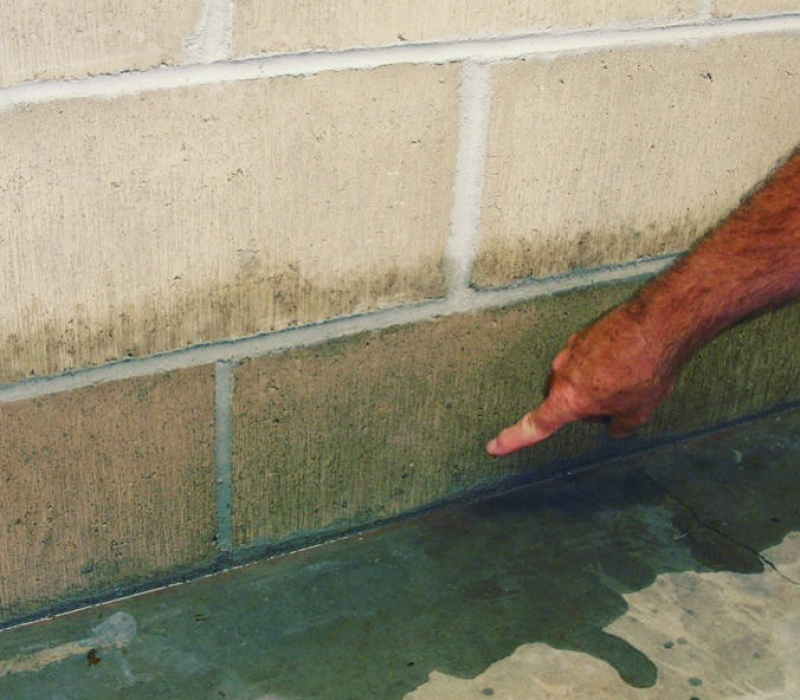
The cove joint is where the floor slab meets the foundation wall.
Water under pressure often appears as a line of wetness along that joint even when the wall face looks dry higher up.
How We Tell the Moisture Sources Apart
Diagnosis uses pattern, timing, and location—not only how wet the floor feels. Clues we look for include:
- Wetness during or after rain versus wetness on dry days
- Moisture on cold pipes and tanks but a dry cove joint
- A wet stripe at the wall-floor joint after storms
- Water isolated under a window well
- Water tracking from a water heater, washer, or exposed pipe
- Efflorescence or mineral staining on lower walls
- High indoor humidity while the soil outside is not loaded
- A sump that is cycling versus a pit that is dry while the floor is wet
A dry sump with a wet floor often means the water is not reaching the pit.
That points to a different path than a failed pump.
A wet pit and a wet floor may still be a pump problem—or inflow the pump cannot match. Repair follows that distinction.
Signs You Need Professional Wet Basement Repair
Professional diagnosis is often needed when:
- You have tried dehumidifiers, paint, or fans and the wetness returns
- You cannot tell if the water is from rain, a leak, or humidity
- The same corner wets after every storm
- A window well area is the only wet zone
- You smell mustiness but see only occasional dampness
- Finished flooring is failing at the perimeter
- Stored items on the slab keep getting damaged
- Multiple possible sources exist in the same basement
If the cause is still a guess, repair should not start with demolition of the entire perimeter.
It should start with identifying the path.
Why DIY Wet Basement Repair Is Risky
Hardware-store waterproofing paint, random caulk at the cove, and a bigger dehumidifier are common first attempts.
They sometimes help condensation. They often hide seepage or a leak until damage is worse.
DIY wet basement repair may:
- Seal a wall face while water still enters at the footing
- Treat condensation as seepage and open floors unnecessarily
- Miss a plumbing leak because it only drips behind a tank
- Fill a window well with gravel and leave the well drain clogged
- Assume a working sump means the floor cannot be seeping elsewhere
- Mix bleach into a moisture problem and call it solved
- Delay a real leak until it soaks more of the slab
Professional repair is diagnosis plus the matching correction.
Skipping diagnosis is how people buy the wrong product twice.
Our Wet Basement Repair Process
Every basement is different, but repair typically follows a diagnostic sequence.
• 1. Interview the Pattern
We ask when the space gets wet, which rooms are involved, and whether weather or plumbing use lines up with the moisture.
• 2. Visual and Moisture Mapping
We inspect cove joints, window wells, plumbing, cold surfaces, and storage.
Wet zones are mapped instead of described as “the whole basement.”
• 3. Separate Condensation from Liquid Entry
We determine whether water is forming on surfaces from air or arriving as liquid through a path.
• 4. Isolate Plumbing vs. Groundwater vs. Well vs. Joint
Leaks, seepage, window wells, and cove-joint flow are confirmed or ruled out. The repair list stays short and accurate.
• 5. Repair the Identified Path
Plumbing leaks are repaired as plumbing.
Window-well drainage is corrected at the well. Condensation is addressed as humidity and surface temperature.
Seepage and cove-joint groundwater get the drainage or waterproofing repair that fits—not a generic coating.
• 6. Confirm Related Systems
If a sump exists, we check whether water is reaching it and whether the pump can discharge.
If it does not exist, we do not invent a pump as the answer to condensation.
• 7. Recheck After Correction
Repair is verified against the original pattern so the wet corner is not simply moved.
• 8. Explain What Was Not the Cause
You leave knowing what was ruled out. That prevents the next round of the wrong product.
Condensation: Repair Without Fake Waterproofing
Condensation repair is not a drain tile project.
It is about humid air and cold surfaces. Typical condensation-related work may include:
- Finding moisture sources in the air (dryers, unvented spaces, wet storage)
- Improving ventilation or dehumidification as humidity control, not as a seepage cure
- Insulating cold pipes that drip onto the slab
- Reducing indoor moisture loads that bead on concrete
If the cove joint is dry during rain and the pipes are sweating, opening the footing is the wrong repair.
Wet basement repair includes the honesty to say that.
Seepage and Cove-Joint Repair
When diagnosis shows groundwater seepage, repair targets the foundation moisture path.
That may involve interior collection at the footing, wall drainage, crack management, or another method suited to the evidence.
Cove-joint seepage is liquid water at the slab-wall line, often after rain. Wiping the joint does not change pressure. Repair is still diagnosis-led:
- One wet wall may not require opening every wall
- A pattern at the joint points to footing-level collection, not only wall paint
- Seepage with a dry plumbing system should not be treated as a pipe leak
This article does not prescribe one product for every seeping basement. Seepage should be repaired as a soil-and-foundation path.
Plumbing Leaks in a Wet Basement
Many basements are blamed on groundwater when a fitting, heater, or drain is the source. Plumbing-related wet basement repair includes:
- Locating supply and drain leaks that wet the slab
- Checking water heaters, softeners, washers, and hidden valves
- Distinguishing a leak that runs on dry days from seepage that tracks storms
- Repairing the failed plumbing so the floor can dry
If the water is from a leak, the repair is plumbing. Waterproofing the walls will not stop that pipe. Diagnosis exists so those two jobs are not confused.
Window Wells as a Localized Wet Zone
A window well can soak one area of an otherwise manageable basement. Leaves or a clogged well drain can fill the well until water comes over the sill.
Window-well repair may include:
- Clearing and correcting the well drain
- Addressing how rain and snowmelt enter that well
- Checking the window and well joint for a liquid path into the room
- Confirming the rest of the basement is not seeping independently
If only the well wall is wet, a full-perimeter drain may be the wrong first move.
Wet Basement Repair for Residential Properties
Homeowners usually call when a basement used for living or storage will not stay dry and the cause is unclear. Typical diagnosis involves:
- Family rooms finished over a slab that wets at the edges
- Unfinished storage with repeating damp boxes
- Mechanical rooms with mixed pipes, tanks, and foundation walls
- Homes where one window well floods while the rest of the basement is only damp
- Seasonal wetness that might be seepage or might be summer condensation
We help households stop treating every wet floor as the same emergency. The repair that follows is the one the pattern supports.
Wet Basement Repair for Commercial Buildings
Commercial lower levels mix inventory, mechanicals, and occupied space. A wet floor can be a slip hazard or a stock loss. Repair often addresses:
- Mapping which bays or rooms wet and on what schedule
- Separating process water or plumbing from groundwater
- Window wells and areaways at commercial lower-level openings
- Documentation of findings for ownership and facility records
- Repairs that can be sequenced around occupancy
Facility managers need a cause, not a catalog of products. We diagnose first so the repair budget lands on the path that is actually wet.
Wet Basement Repair for Landlords and Property Managers
Tenants report “the basement is wet.” That report is a symptom. Ownership still needs a cause. We assist with:
- Unit or shared-basement moisture mapping
- Distinguishing tenant plumbing issues from building seepage
- Clear notes on condensation versus liquid entry
- Repairs that match the path without overselling a full system
- Guidance on what occupants should not seal over while waiting
Incomplete diagnosis in a rental building leads to arguments about whose problem the water is. A mapped path is easier to act on.
Wet Basement Repair Cost Factors
Cost varies because causes vary. A pipe repair is not priced like perimeter drainage. Factors that commonly affect cost include:
- How many moisture sources are present
- Whether the repair is plumbing, well drainage, condensation control, or seepage work
- Access, finishes, and how much of the basement must be opened
- Whether a sump and drains already exist and are relevant
- How long the path has been wetting finishes and contents
- Occupied-building constraints
- Follow-up verification after the first correction
An on-site diagnosis is what makes an estimate meaningful. Phone photos of a wet corner cannot always tell condensation from cove-joint flow.
Insurance and Wet Basement Documentation
Insurance treatment of basement water depends on the policy and the cause. Sudden leaks and seepage are often viewed differently.
We do not promise coverage. Helpful documentation during wet basement repair includes:
- Photos of wet patterns, window wells, plumbing, and cove joints before major work
- Notes on timing (storm-related vs. continuous vs. seasonal humidity)
- Records of what source was identified and what repair was performed
- What was ruled out, so the file does not imply a cause that was not found
We help capture what the basement was doing. Your insurer decides how the policy applies.
What Wet Basement Repair Does Not Include
It is useful to know where this service stops. Wet basement repair is not:
- A single product sold before diagnosis
- Automatic full interior or exterior waterproofing of the entire foundation
- Flood cleanup after a sudden high-volume indoor release
- A guarantee that soil moisture will never return if we repaired a different path
- Mold removal of established growth as a default add-on
- Guaranteeing insurance payment
If diagnosis shows you need interior drainage, a pump repair, or plumbing work, those can be the repair. They are not assumed at the start.
Benefits of Hiring Plumber On Demand for Wet Basement Repair
Wet basements attract generic solutions. Diagnosis is how you avoid the generic. When you choose Plumber On Demand, you benefit from:
• Cause-First Planning
Condensation, seepage, leaks, wells, and cove joints are separated before tools come out.
• Repair That Matches the Path
You are not pushed into one product for every damp slab.
• Plumbing and Moisture Together
Leaks are not ignored in favor of waterproofing theater.
• Clear Communication
You know what was found, what was repaired, and what was not the cause.
• Residential and Commercial Support
We work with homeowners, landlords, property managers, and business owners.
Seasonal Patterns and Why Timing Matters
Spring thaw and rain load the soil. Summer humidity loads the air. Seasonal clues help diagnosis:
- Wet only in thaw and rain → look at seepage, cove joint, and wells
- Wet on pipes in humid months with a dry joint → look at condensation
- Wet any day the laundry runs → look at plumbing and appliances
- Wet under one window after storms → look at that well first
Repair in the dry season can still be valid, but the original pattern should be recorded.
A basement that is dry on the day of the visit may still show a storm-related path in staining, mineral lines, and owner history.
Mixed Causes in the Same Basement
One basement can have more than one moisture path. A sweating pipe and a wet cove joint can both be true.
Repair still proceeds one confirmed path at a time. Fixing a leak does not excuse ignoring seepage.
We map each wet zone so mixed causes are listed, not blended into one vague “damp basement” label.
Areas We Serve
Plumber On Demand provides wet basement repair services for residential and commercial properties across a wide range of communities.
We work with:
- Homeowners
- Property managers
- Landlords
- Contractors
- Business owners
- Facility managers
- Real estate professionals
The Importance of Acting Quickly
Moisture that repeats will keep wetting the same materials. The wrong delay is waiting while you try another coating.
The right speed is diagnosing the path before more finishes and contents are involved. Prompt wet basement repair can help:
- Catch a plumbing leak before it is mistaken for always-wet concrete
- Stop seepage from soaking stored goods another season
- Correct a window well before it becomes a chronic indoor puddle
- Address condensation before odor is treated as a mystery
- Document conditions while the pattern is visible
If the basement is wet now, that is information. Waiting until it dries can erase clues that make diagnosis faster.
Schedule Wet Basement Repair Today
If your basement is wet and you need to know why, Plumber On Demand is ready to help.
Our wet basement repair services focus on diagnosing the moisture path and repairing that path. We do not sell a single product for every damp floor.
Contact Plumber On Demand today at 226-500-7228 to schedule a wet basement repair assessment.
Finished Rooms vs. Bare Slabs
A finished basement hides the cove joint. A bare slab shows staining, but storage can still cover evidence. During diagnosis we plan:
- What finishes must be viewed or opened to see the joint
- How to inspect plumbing without assuming the finish is the source
- Whether a localized wet zone can be confirmed without opening the entire perimeter
- How repair in a finished room differs from repair in an open storage basement
The moisture path does not care about carpet. Repair still has to reach it. Diagnosis decides how much of the finish is involved.
Why Homeowners Trust Plumber On Demand
A wet basement is confusing. Advice from neighbors often starts with a product, not a cause. Clients choose Plumber On Demand because we offer:
• Diagnosis Before Demolition
We identify condensation, seepage, leaks, wells, and cove-joint flow first.
• Matched Repairs
The correction fits the path instead of a one-product pitch.
• Practical Next Steps
You get a clear explanation of why it was wet and what was done so it stays dry for that reason.
Frequently Asked Questions About Wet Basement Repair
• Why is my basement wet if it is not raining?
Condensation and plumbing leaks can wet a basement on dry days. Seepage is more likely to track wet soil and storms.
• What is the cove joint?
The line where the floor slab meets the foundation wall. Groundwater often appears there as a wet stripe even when the upper wall looks dry.
• Is a wet basement always a waterproofing job?
No. It may be humidity, a leak, or a window well. Waterproofing is one possible repair after seepage is confirmed.
• Can a dehumidifier fix seepage?
A dehumidifier can help with damp air. It does not stop liquid groundwater at the cove joint or a leaking pipe.
• How do you tell condensation from seepage?
Location and timing. Condensation prefers cold pipes and tanks and humid weather. Seepage prefers joints, cracks, and storms.
• Could it be a plumbing leak?
Yes. Supply, drain, and appliance leaks are common and do not wait for rain. We check plumbing as part of wet basement repair.
• What about the window well?
If water is concentrated under a basement window, the well and its drain are a prime suspect before a full-foundation project.
• Do I need a new sump pump?
Only if water is reaching an existing pit and the pump is the failure. A dry pit with a wet floor points elsewhere.
• Does insurance cover wet basement repair?
Coverage depends on your policy and the cause. We document findings; we do not decide coverage.
• Will you just coat the walls?
Not as a default. Coatings do not repair a leak, a well, or hydrostatic flow at the joint. We repair the path that diagnosis shows.
• How long does diagnosis take?
A focused inspection can often identify the likely path in a visit. Hidden plumbing or mixed causes may need more testing.
• How do I get started?
Call Plumber On Demand at 226-500-7228 to describe when and where the basement gets wet and schedule a wet basement repair assessment.
Contact Plumber On Demand Today
A wet basement is a moisture path, not a mystery stain. Each source needs a different repair.
Plumber On Demand provides wet basement repair services for residential and commercial clients.
If you need help diagnosing and repairing a wet basement, contact Plumber On Demand today.
📞 Call 226-500-7228
Speak with our team about the pattern in your lower level, request an assessment, and learn how cause-first repair can help.