
Water Damage Restoration Binbrook
 (459)
(459)
(459)

Professional Water Damage Restoration Services | Plumber On Demand
Mitigate, Dry, and Restore Finishes to Pre-Loss Condition After Water Damage
Water damage restoration is the full cycle after water has damaged a property: stop the loss from getting worse, dry what can be dried, then restore finishes—drywall, paint, flooring, and trim—toward pre-loss condition. Cleanup and drying alone leave a property stable but unfinished. Restoration is the work of putting the building back together so rooms look and function as they did before the damage.
At Plumber On Demand, we provide water damage restoration services that connect mitigation, drying, and finish repair into one path. Our goal is not only to make the space dry, but to restore the surfaces occupants actually live with.
If you need water damage restoration after a leak, overflow, or indoor flooding, contact Plumber On Demand today at 289-501-6316 to schedule an assessment.
What Water Damage Restoration Means
Water damage restoration means returning damaged finishes to a condition that reasonably matches the property before the loss.
A restoration cycle commonly includes:
- Mitigating ongoing damage (extraction, source control, protecting unaffected areas)
- Drying remaining structural materials
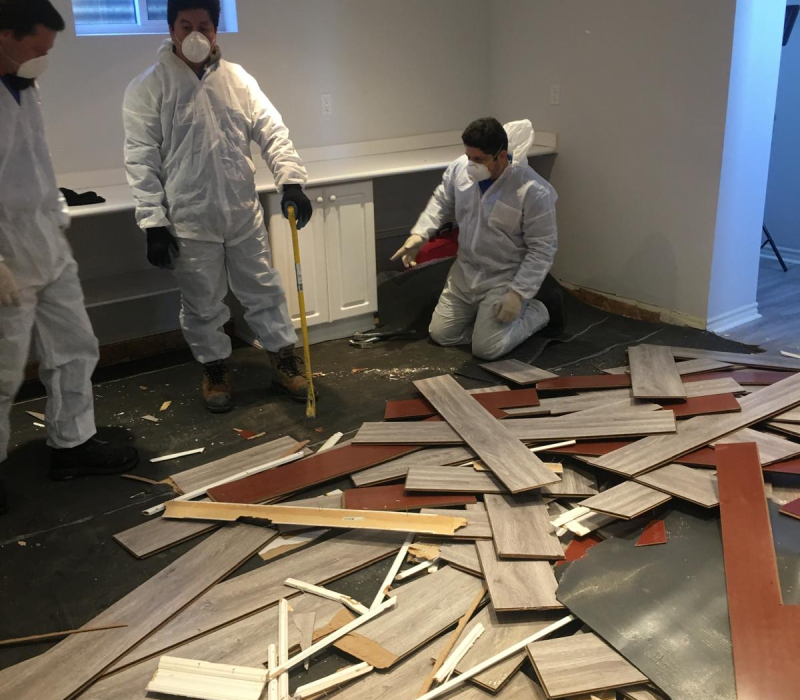
- Removing finishes that cannot be restored
- Rebuilding drywall, trim, and flooring where needed
- Paint, finish, and detail work to match surrounding areas
- Resetting rooms so they are complete, not merely dry
Restoration is finish-focused. It is the difference between “the leak is handled” and “the wall, floor, and trim look like a finished room again.”
Why Water Damage Restoration Is Important
A dried, unfinished room is still a loss. Open drywall, missing baseboards, and unfinished floors affect livability, appearance, and property value.
Professional restoration helps:
- Return rooms to a finished, usable appearance
- Match repairs to existing paint, trim, and flooring where practical
- Close wall cavities after wet materials were removed
- Reduce the period when a home or business looks like a job site
- Complete the work that mitigation started
- Avoid leaving “temporary” unfinished areas that linger for months
Restoration is how water damage stops being a visible scar on the property.
Common Causes That Lead to Finish Restoration
Restoration is needed whenever water damage removed or ruined finishes.
Typical causes include:
- Supply-line and fixture failures that wet drywall and flooring
- Overflows that forced removal of baseboards and wall bases
- Appliance leaks that damaged kitchen or laundry finishes
- Ceiling leaks that ruined drywall and paint
- Finished-basement wetting that damaged flooring systems
- Backups that required removal of porous finishes
The cause determines how much finish is lost. Restoration planning starts from what was actually removed or ruined, not from a generic remodel.
Signs You Need Restoration, Not Only Drying
You likely need restoration when:
- Drywall has been cut out or is too damaged to remain
- Paint is peeling, stained, or missing after repairs
- Flooring was lifted, cupped, or removed
- Trim and baseboards were pulled for drying or demolition
- Rooms are dry but unfinished
- Patches do not match surrounding texture or color
- Cabinets, doors, or finishes still show water-related distortion
If the property is stable but does not look like it did before the loss, restoration is the remaining work.
Why DIY Restoration After Water Damage Often Fails
Mitigation and restoration are different skills. Finishing a water-damaged room is not the same as painting a spare bedroom.
DIY restoration may:
- Close walls before materials are truly dry
- Mismatch texture, paint sheen, and trim profiles
- Leave flooring transitions that trip or look unfinished
- Skip primer on stained drywall so marks bleed through
- Restore cosmetics while cavities still hold moisture
- Create a finished look over materials that should have been replaced
Professional restoration sequences drying and rebuild so finishes are not installed over a still-wet loss.
Our Water Damage Restoration Process
Restoration follows a cycle from mitigation through finished surfaces.
• 1. Mitigation
We help stop further damage: source issues, extraction as needed, and protection of undamaged finishes.
• 2. Evaluation of Finish Loss
We document which drywall, paint, flooring, and trim can be saved versus rebuilt.
• 3. Drying of Remaining Structure
Remaining framing and substrates are dried so restoration is not built on damp materials.
• 4. Removal of Unrestorable Finishes
Damaged drywall, flooring, and trim that cannot return to pre-loss condition are removed.
• 5. Drywall Restoration
Replacement board, taping, and finishing restore wall and ceiling planes.
• 6. Flooring Restoration
Saved floors are detailed; replaced floors are installed to complete the room.
• 7. Paint and Trim Restoration
Primer, paint, baseboards, and casing are restored to blend with surrounding finishes.
• 8. Pre-Loss Walkthrough
We review the restored areas against the goal of a complete, finished room.
Restoring Drywall and Paint After Water Damage
Drywall restoration is more than hanging a patch.
It typically includes:
- Replacing removed sections to existing edges
- Matching texture as closely as practical
- Priming stains so they do not telegraph through paint
- Painting to blend with adjacent walls and ceilings
- Restoring corner bead and details that water ruined
A water stain painted over without proper restoration often returns as a visible mark. Restoration treats the finish system, not only the stain.
Restoring Flooring After Water Damage
Flooring restoration may mean repair or replacement, depending on product and damage.
• Repair-Oriented Restoration
Some hard floors can be cleaned, dried, and detailed back into service if they remained sound.
• Replacement-Oriented Restoration
Cupped, swollen, or delaminated floors, and pad-and-carpet systems that were removed, need new material to restore the room.
• Transitions and Matching
Pre-loss condition includes transitions, height, and appearance next to undamaged rooms. Restoration planning includes those details so the repair does not look like a leftover patch.
Trim, Doors, and Finish Carpentry
Water damage restoration often includes the small finishes people notice first.
Common trim restoration includes:
- Baseboards removed for wall cuts
- Casing around doors that swelled or stained
- Quarter-round and transitions at floors
- Doors that no longer fit after swelling
Restoring trim is part of returning the room to pre-loss condition. Bare drywall with no baseboard is not a restored room.
Residential Water Damage Restoration
Homeowners usually want bedrooms, kitchens, baths, and living rooms to look finished again.
Residential restoration often includes:
- Wall and ceiling repairs after plumbing leaks
- Paint blending in occupied living space
- Flooring repairs in hallways and adjacent rooms
- Trim restoration after baseboard removal
- Coordinating work so the home can be lived in during later stages
The standard is pre-loss condition of the finishes, not a full remodel unless the owner chooses upgrades.
Commercial Water Damage Restoration
Commercial restoration must return spaces to a professional, usable appearance.
Commercial needs often include:
- Matching commercial paint and flooring systems
- After-hours finishing to limit downtime
- Restoring customer-facing areas quickly
- Coordinating with occupancy and access rules
- Completing work so the space does not remain a construction zone
Offices, retail, restaurants, warehouses, multi-unit buildings, and service facilities all need finish restoration after water damage—not only a dry shell.
Save vs. Replace During Restoration
Restoration tries to return finishes to pre-loss condition. Sometimes that means repairing; sometimes it means replacing to get the same result.
More often repaired:
- Limited drywall with sound framing behind it
- Paint systems that can be primed and blended
- Trim that remained straight and can be reset
- Some hard floors with minor, correctable issues
More often replaced to restore the look:
- Swollen drywall and wet insulation
- Cupped or delaminated flooring
- Contaminated porous finishes
- Trim that cracked or distorted
- Finishes that cannot be matched with a small patch
The restoration question is: what action returns this finish to pre-loss condition?
What Water Damage Restoration Costs
Restoration cost follows the quantity of finish that must be rebuilt.
Cost drivers include:
- Square footage of drywall and paint
- Flooring type and how much must be replaced
- Trim profiles and linear footage
- Ceiling vs. wall work
- Matching existing finishes vs. a defined repair zone
- Occupied-building constraints
- How much mitigation and drying must happen before finishing
A single wall patch costs less than restoring several rooms of flooring, drywall, and paint. Scope should be based on pre-loss condition, not on the cheapest cover-up.
Insurance and Water Damage Restoration
Many water-loss claims include restoration of damaged finishes to pre-loss condition, subject to policy terms.
Helpful practices include:
- Photos of finishes before and after the loss when available
- Distinguishing mitigation, drying, and restoration line items
- Notes on matching paint, flooring, and trim
- Clarifying what is repair vs. betterment if you choose upgrades
Plumber On Demand can describe restoration work needed to return finishes. Coverage remains between you and your insurer.
Preventing Repeat Finish Loss
Restoration should not be undone by the next leak.
Prevention after restoration includes:
- Correcting the plumbing or building issue that caused the loss
- Leak alarms near appliances and water heaters
- Maintaining supply lines
- Not closing cavities until drying is complete
- Addressing slow leaks before they ruin new finishes
New drywall and paint over an unfixed leak is not restoration; it is a short delay.
Why Choose Plumber On Demand for Water Damage Restoration
Restoration is a cycle, not a single trade visit.
When you choose Plumber On Demand, you benefit from:
• Full-Cycle Thinking
Mitigate, dry, then restore finishes—so work is sequenced correctly.
• Finish Quality as the Goal
Pre-loss condition of drywall, paint, flooring, and trim is the standard.
• Plumbing-Aware Restoration
We understand the failures that wet finishes and the repairs that should happen before walls close.
• Clear Scope
You know what will be rebuilt and what can be saved.
• Residential and Commercial Support
We work with homeowners, landlords, property managers, and business owners.
Matching Materials and Aesthetics
Pre-loss condition includes appearance.
Matching challenges may include:
- Paint color and sheen
- Drywall texture
- Flooring dye lots and plank direction
- Trim profile and height
- Caulk and finish details at edges
Perfect factory matches are not always possible with aged materials. Restoration aims for a reasonable pre-loss appearance and explains where a broader paint or flooring blend is the better result.
Timeline From Mitigation to Restored Finishes
A typical restoration timeline is a sequence, not a single day.
• Stabilization
Extraction and protection happen first.
• Drying
Structural materials must be dry enough to restore.
• Rebuild
Drywall, flooring, and trim go back in.
• Finish
Paint, detail, and cleanup complete the room.
Skipping ahead to paint or flooring to “get it over with” is how restoration fails. The cycle exists to protect the new finishes.
Areas We Serve
Plumber On Demand provides water damage restoration services for residential and commercial properties across a wide range of communities.
We work with:
- Homeowners
- Property managers
- Landlords
- Contractors
- Business owners
- Facility managers
- Real estate professionals
If your property is dry but unfinished after water damage, we can help restore finishes.
The Importance of Completing Restoration
Leaving a property in a mitigated-but-unfinished state can lead to:
- Damage to open cavities
- Occupant frustration and reduced use of rooms
- Harder matching later as surrounding finishes age further
- Temporary patches that become permanent by neglect
Completing restoration is how the loss actually ends.
Schedule Water Damage Restoration Today
If water damage left unfinished drywall, missing flooring, or damaged trim and paint, Plumber On Demand is ready to help restore those finishes.
Our water damage restoration services focus on the full cycle: mitigate, dry, and restore to pre-loss condition.
Contact Plumber On Demand today at 289-501-6316 to schedule restoration service.
Coordinating Trades During Restoration
Restoration often involves more than one skill: drying, drywall, flooring, paint, and sometimes plumbing or electrical checks before walls close.
Coordination helps:
- Avoid installing floors before walls are finished when sequencing requires it
- Paint after drywall is actually ready
- Keep plumbing repairs from being buried unfinished
- Reduce repeat visits that damage new finishes
Plumber On Demand plans restoration as a sequence so trades are not working against each other.
Kitchens, Baths, and High-Finish Rooms
These rooms show restoration quality quickly. Restoration in kitchens and baths may include cabinet-base and flooring details, moisture-resistant finishing choices where appropriate, paint and caulk at wet-area transitions, and trim around fixtures after wall repairs.
The goal remains pre-loss condition of the finishes, with attention to rooms where water and daily use will test the repair.
Ceilings After Upstairs Leaks
Ceiling restoration after water damage is finish work with extra sequencing.
Typical ceiling restoration includes:
- Replacing removed drywall on the ceiling plane
- Texture matching that is often more visible than wall patches
- Stain-blocking primer before paint
- Checking fixtures and penetrations before closing
- Blending paint across the ceiling so a patch does not read as a cloud
Because ceilings are seen in large unbroken fields, restoration quality shows. Pre-loss condition here usually means a uniform finished ceiling, not a square of new paint in the middle of an aged surface.
Cabinets, Doors, and Built-In Finishes
Water often damages the finishes people use every day.
Restoration may include:
- Cabinet toe-kicks and end panels after appliance or supply leaks
- Interior doors that swelled and no longer latch
- Built-in shelving and closet systems
- Window trim that wicked water from a leak above
These items are part of pre-loss condition. A newly painted wall next to a swollen door is not a finished restoration.
If cabinets only took water at the toe-kick, restoration may be limited to that zone. If doors, drawers, and end panels distorted, replacement may be the only way to return pre-loss function and appearance.
• Hardware and Fit
Restored doors and cabinets should close, latch, and align. Pre-loss condition includes function, not only paint.
Frequently Asked Questions About Water Damage Restoration
• Is restoration the same as drying?
No. Drying stabilizes materials. Restoration rebuilds and finishes drywall, paint, flooring, and trim.
• Will my walls look the same as before?
The goal is pre-loss condition. Texture and paint are matched as closely as practical; aged finishes sometimes need a broader blend.
• How long before you can hang new drywall?
New drywall should wait until remaining structure is dry enough. That timeline depends on the loss, not a single calendar rule.
• Do you restore flooring or only walls?
Restoration includes flooring when floors were part of the damaged finishes.
• Can you just patch the stained spot?
Sometimes. If the material is sound and staining can be sealed, a targeted restoration may work. Soft or removed materials need rebuild.
• What is pre-loss condition?
It means returning damaged finishes to a reasonable match of how they were before the water damage—not a full upgrade unless you choose one.
• Does insurance pay for restoration?
Many policies address restoring damaged finishes, subject to cause and coverage. Document finishes and ask your carrier.
• Can I live at home during restoration?
Often yes, depending on which rooms are in work. Dust, paint, and flooring stages may limit use of specific areas.
• What if I want better flooring than I had?
That is betterment. Restoration covers pre-loss condition; upgrades can be discussed as a separate choice.
• Do you restore commercial spaces?
Yes. Commercial restoration focuses on returning usable, finished areas with attention to downtime.
• Why not paint as soon as it looks dry?
Surface-dry is not the same as ready to restore. Closing or painting over damp materials can trap moisture and ruin the new finish.
• How do I get started?
Call Plumber On Demand at 289-501-6316 to discuss restoration of your damaged finishes.
Contact Plumber On Demand Today
Water damage restoration is the full cycle after a loss: mitigate, dry, and restore drywall, paint, flooring, and trim to pre-loss condition. A dry, unfinished room is not a restored room.
Plumber On Demand provides water damage restoration services for residential and commercial clients.
If you need damaged finishes restored after water damage, contact Plumber On Demand today.
📞 Call 289-501-6316
Speak with our team about your situation, request an assessment, and learn how our water damage restoration services can help return your finishes to pre-loss condition.